Official websites use .gov
A .gov website belongs to an official government organization in the United States.

Secure .gov websites use HTTPS
A lock ( ) or https:// means you’ve safely connected to the .gov website. Share sensitive information only on official, secure websites.

Indicators

River Discharge

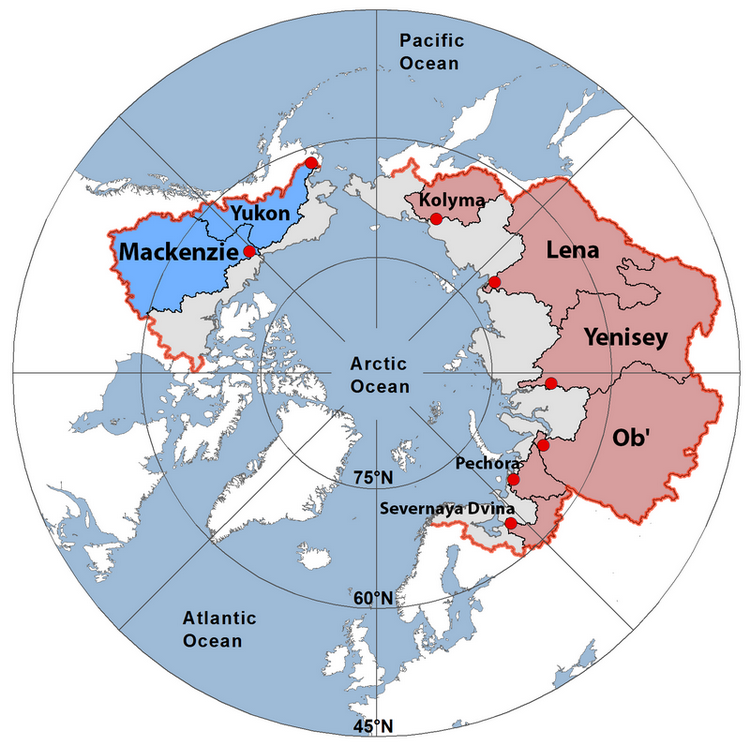
The Arctic Ocean contains only about 1% of global ocean volume but receives greater than 10% of global river discharge. Consequently, terrestrial influences via river inputs are much stronger in the Arctic Ocean than in other ocean basins. Rapid change in the Arctic system is altering land-ocean linkages, impacting coastal and ocean physics, chemistry, and biology. 

River Discharge Read More »

Fig. 1. Lake ice freeze-up anomalies in 2017/18 relative to the 2004-17 mean from the NOAA IMS 4-km product. Specific regions and lakes referred to in the text are highlighted.

Lake Ice

Lake ice is an important component of the cryosphere for several weeks to several months of the year in high-latitude regions. The presence (or absence) of ice cover on lakes during the winter months affects both regional weather and climate (e.g., thermal moderation and lake-induced snowfall). Hence, monitoring of lake ice is critical to our skill at regional forecasting.

Lake Ice Read More »

Migratory Tundra Caribou and Wild Reindeer

The abundance of migratory herds of caribou (North America and Greenland) and wild reindeer (Russia and Norway) in circum-arctic tundra regions has declined 56% over the last two decades. Caribou and wild reindeer are a key species in the arctic food web contributing to nutrient cycling between terrestrial and aquatic systems and the abundance of predators and scavengers.

Migratory Tundra Caribou and Wild Reindeer Read More »

Ocean Acidification

Over the past five years, ocean acidification (OA) has emerged as one of the most prominent issues in marine research. This is especially true given the newfound public understanding of the potential biological threat to marine calcifiers (e.g. clams, pteropods) and associated fisheries, and the associated human impacts for small communities that directly or indirectly rely on them (e.g., Mathis et al., 2015a; Frisch et al., 2015). Cooler water temperatures and unique physical processes (i.e. formation and melting of sea ice) make the waters of the Arctic Ocean disproportionately sensitive to OA when compared to the rest of the global ocean. Even small amounts of human-derived carbon dioxide (CO2) can cause significant chemical changes that other areas do not experience, and these could pose an existential threat to some biological organisms.

Ocean Acidification Read More »

Terrestrial Carbon Cycle

The Arctic continues to warm at a rate that is currently twice as fast as the global average. Warming is causing normally frozen ground (permafrost) to thaw, exposing significant quantities of organic soil carbon to decomposition by soil microbes (Romanovsky et al. 2010, Romanovsky et al. 2012). This permafrost carbon is the remnants of plants, animals, and microbes accumulated in frozen soil over hundreds to thousands of years (Schuur et al. 2008). The northern permafrost zone holds twice as much carbon as currently in the atmosphere (Schuur et al. 2015, Hugelius et al. 2014, Tarnocai et al. 2009, Zimov et al. 2006). Release of just a fraction of this frozen carbon pool, as the greenhouse gases carbon dioxide and methane, into the atmosphere would dramatically increase the rate of future global climate warming (Schuur et al. 2013).

Terrestrial Carbon Cycle Read More »

Shrews and Their Parasites: Small Species Indicate Big Changes

When natural environments change, species may shift their distributions, adapt to novel conditions, or die out. Consequently, accelerating climate change is already recognized as leading to considerable range expansion and contraction, evolutionary changes, and extinction for hosts, parasites, and diseases through the Arctic (e.g., Kutz et al., 2013; Meltofte et al., 2013). Ultimately, these perturbations have consequences for wildlife and humans at high latitudes (e.g., Dudley et al., 2015). Complex host-parasite systems are critical proxies for understanding change in northern regions due to species interactions that determine the distribution of parasites and disease over space and time (e.g., Hoberg et al., 2012, 2013). Life histories for helminth parasites (tapeworms, flukes, roundworms) often involve circulation among mammalian hosts (where adult parasites reside) and other vertebrate and invertebrate species (where larval or developing parasites reside). Other parasites (viruses, bacteria, protozoans) circulate through vectors such as blood feeding arthropods or through direct transmission. These complex life cycles are closely tied to environmental conditions, define linkages across communities, and scale from individuals to ecosystems.

Shrews and Their Parasites: Small Species Indicate Big Changes Read More »

Scroll to Top

Contact Our Team

Fill out the form below, and we will be in touch shortly.
Contact Information
Vehicle Information
Preferred Date and Time Selection